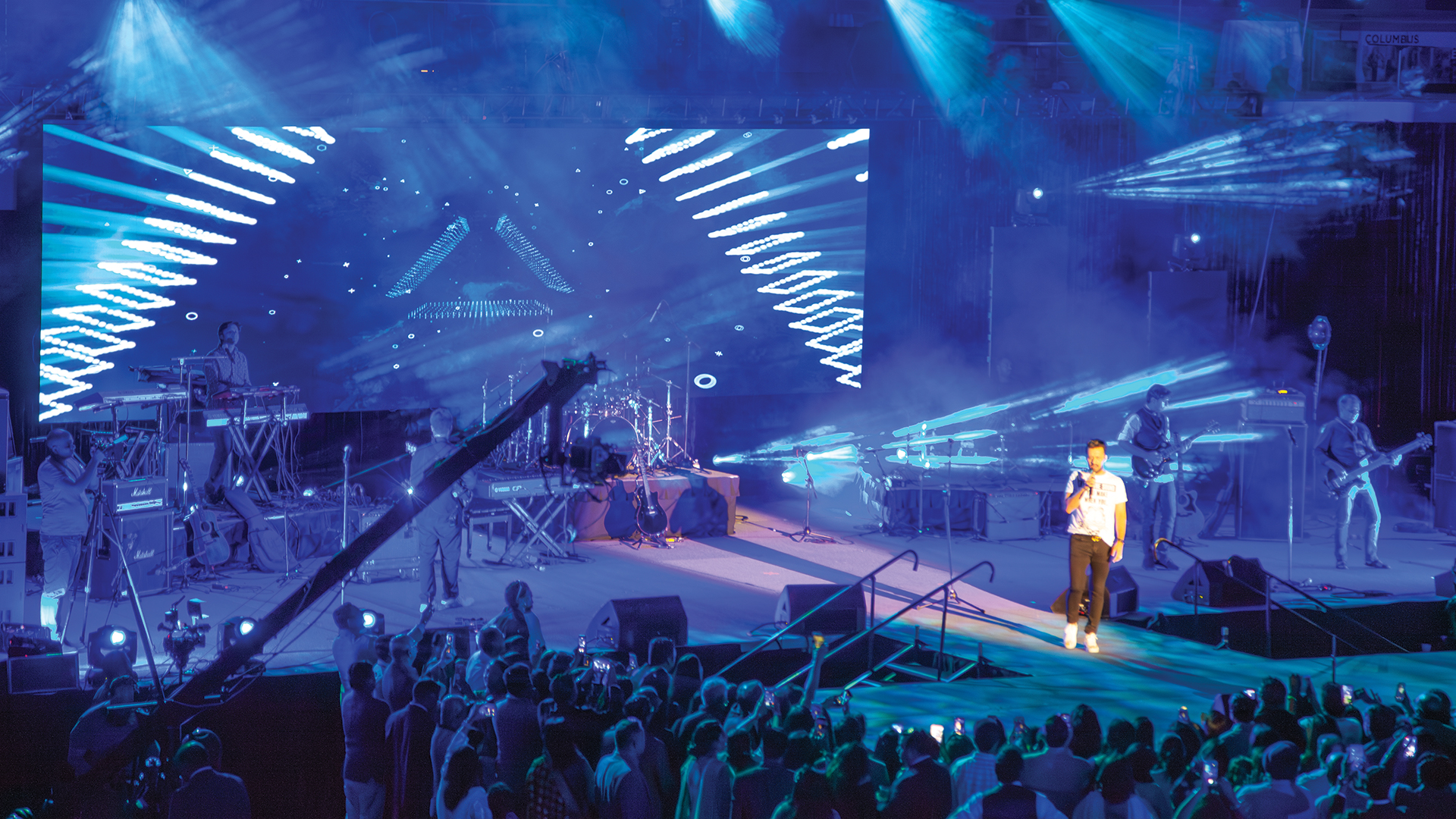
The video content had been designed by an award-winning studio, rendered at native resolution, and delivered in the exact format the media server required. The ROE Visual CB5 panels were configured correctly, calibrated using Brompton Tessera processing, and mapped with precision. Yet when the content played, it looked fundamentally wrong—proportions distorted, perspectives skewed, and the creative director’s vision transformed into something resembling a funhouse mirror.
The Geometry of LED Reality
LED walls don’t exist on flat planes in a vacuum. They curve around stages, angle toward audiences, and form complex dimensional shapes that content creators often don’t fully consider. A designer working in After Effects sees rectangular frames; the LED technician sees modular panels arranged in three-dimensional space. Bridging this gap requires understanding how perspective transforms content across non-planar surfaces.
The disguise media server platform addresses this challenge through projection mapping capabilities that can warp content to compensate for physical surface geometry. But warping introduces its own artifacts: resolution loss in stretched areas, visible distortion at extreme angles, and computational overhead that can affect playback performance. The mathematics of perspective correction aren’t magic—they’re compromises.
The Viewing Angle Variable
Where audiences sit relative to LED surfaces determines what they perceive. Content designed to look perfect from a centered position might appear distorted from seats at extreme angles. The pixel pitch that seems fine from the back row might reveal visible pixel structure from front orchestra. Different sections of the same audience see fundamentally different versions of the same content.
Concert productions increasingly use curved LED configurations that wrap around audiences, creating immersive environments. The video designer must consider how content flows across these curves, maintaining visual continuity despite the changing relationship between surface and viewer. Tools like notch enable real-time content generation that adapts to surface geometry, but using these tools effectively requires understanding their limitations.
The Moiré Menace
When camera captures LED walls, interference patterns called moiré often appear—distracting lines or waves that exist only in the captured image. The physical LED pixel grid interacts with the camera’s sensor grid, creating artifacts that no one in the live audience sees but that dominate broadcast imagery. The director of photography for any televised event featuring LED walls must address this phenomenon.
Solutions range from camera technique (defocusing slightly, adjusting scan rates) to LED processing (Brompton’s dynamic calibration features include moiré reduction algorithms). Genlock synchronization between cameras and LED refresh rates can eliminate some interference patterns. But perfect moiré elimination remains elusive—the physics of sampling discrete pixel arrays create inherent challenges that technology manages rather than solves.
Color Science Across Surfaces
The color gamut of LED panels varies by manufacturer, product line, and even manufacturing batch. Content created in Rec. 709 color space might render differently on panels with wider or narrower native gamuts. The brilliant red that looked perfect on the designer’s calibrated monitor might appear orange on certain LED products, or oversaturated on others.
Professional video workflow includes color management at every stage. The colorist working on content needs accurate information about the target display’s characteristics. The LED processing must be configured to interpret incoming signals correctly. On-site calibration using tools like Portrait Displays CalMAN verifies that what plays matches what was intended. This pipeline works when everyone communicates; it fails spectacularly when assumptions replace information.
Resolution and the Scaling Abyss
Content resolution must match display resolution for optimal clarity, but matching is rarely straightforward. A 4K video file playing on an LED wall that isn’t exactly 3840 by 2160 pixels requires scaling. That scaling can be handled by the media server, the LED processor, or both—and each approach produces different quality compromises.
The wisest content producers render at native resolution for their specific LED configuration. This requires knowing that configuration before production begins—information that often isn’t available until tech rehearsal. The alternative is rendering at higher resolution and accepting scaling losses, or creating content in modular formats that can be assembled differently for different installations.
The Refresh Rate Dance
LED panels refresh at specific rates that must align with content frame rates and camera shutter speeds. A panel refreshing at 3,840Hz handles most broadcast scenarios, but lower-specification panels refreshing at 1,920Hz might show banding or flicker in certain capture conditions. The scan rate determines how the panel draws each frame—and different scan rates interact differently with different cameras.
The broadcast engineer testing LED walls for camera compatibility runs extensive trials before any live event. They shoot test patterns at various shutter speeds, review footage frame by frame looking for artifacts, and adjust settings until capture quality meets broadcast standards. This testing phase is non-negotiable for televised events—discovering incompatibility during live broadcast isn’t an option.
Practical Lessons in LED Reality
That production with the warped content eventually achieved acceptable results through extensive on-site adjustment. The video team spent an additional day modifying content parameters, the lighting designer adjusted fixtures to minimize perspective distortion perception, and the director learned which camera angles worked and which to avoid.
The retrospective identified the failure point: insufficient communication between content creators and the technical production team. The creative studio had never received accurate information about the physical LED configuration. The production team had never explained how their installation differed from standard rectangular displays. Both sides assumed the other understood—and perspective played tricks on everyone.
Keywords: video content, media server, ROE Visual CB5, Brompton Tessera, After Effects, LED technician, disguise media server, projection mapping, pixel pitch, curved LED configurations, video designer, notch, moiré, director of photography, Brompton’s dynamic calibration, genlock synchronization, color gamut, Rec. 709, video workflow, colorist, Portrait Displays CalMAN, 4K video file, LED processor, content producers, scan rate, broadcast engineer, video team, lighting designer, director, technical production team
