The Physics of Large-Space Illumination
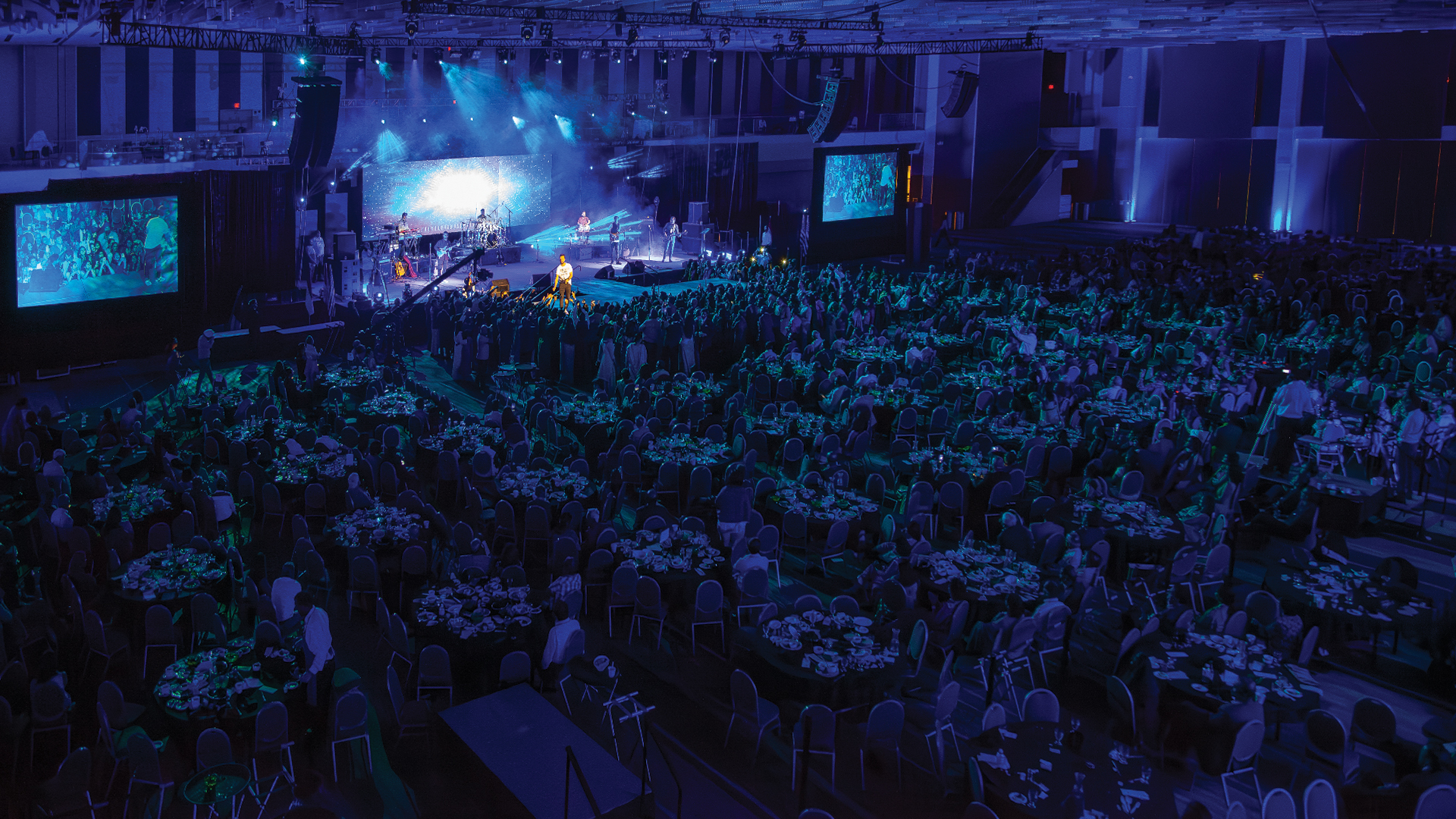
Every lighting designer who has walked into a 50,000-square-foot convention hall understands the sinking feeling: dark pockets lurking between fixture positions, creating visual inconsistency that cameras capture unflatteringly and audiences notice subconsciously. Eliminating these shadows while maintaining visual interest represents one of professional lighting’s fundamental challenges.
The physics governing large-space illumination involve the inverse square law—intensity decreases proportionally to distance squared. A fixture positioned 20 feet above the floor delivers one-quarter the intensity of the same fixture at 10 feet. This mathematical reality shapes every decision about fixture quantity, position, and output. Understanding it transforms guesswork into engineering.
The historical evolution of large-space lighting traces from the gas-lit convention halls of the 19th century through the incandescent era pioneered by General Electric and Westinghouse, into today’s LED and intelligent lighting age. Each technological generation enabled larger spaces while improving efficiency—but dark pocket elimination remained a design challenge across all eras.
The Grid Approach: Mathematical Coverage
The lighting grid methodology—positioning fixtures at regular intervals calculated to ensure overlapping coverage—provides the foundation for large-space illumination. The calculation involves fixture beam angle, mounting height, and target illumination level. For ETC Source Four LED fixtures with 36° beam angles mounted at 25 feet, optimal spacing runs approximately 18-20 feet between units.
Overlapping coverage ensures that the edge falloff of one fixture’s beam meets the edge falloff of adjacent fixtures, eliminating the gaps that create dark pockets. Industry practice targets 20-30% overlap between adjacent fixture coverage areas. Less overlap risks visible variation; excessive overlap wastes fixtures and power.
CAD software including Vectorworks Spotlight and AutoCAD enables designers to plot fixture positions and visualize coverage before installation. These tools calculate foot-candle or lux values across floor plans, identifying dark pocket risks while designs remain adjustable.
Fixture Selection for Even Coverage
Fixture beam angle selection directly affects dark pocket formation. Narrow-beam fixtures (26° or less) create concentrated pools requiring more units for coverage; wide-beam fixtures (50° or more) spread light broadly but may spill onto walls or adjacent spaces. The 36°-50° range typically balances coverage efficiency with spill control for large-room applications.
The luminous intensity (measured in candelas) and luminous flux (measured in lumens) of chosen fixtures determine spacing requirements. High-output fixtures like the Chauvet Maverick Force 2 Profile or Martin ERA 800 space further apart than lower-output alternatives, potentially reducing fixture counts while maintaining illumination levels.
LED versus conventional fixture decisions affect both efficiency and color rendering. Modern RGBW LED fixtures from Elation, Claypaky, and Robe offer color mixing flexibility while consuming less power than tungsten equivalents. The CRI (Color Rendering Index) ratings above 90 ensure that skin tones and products appear natural under LED illumination.
Vertical Surface and Architectural Considerations
Dark pockets form not only on floors but also on vertical surfaces—walls, columns, and architectural features that standard downlighting fails to reach. Dedicated wall washing fixtures positioned to graze surfaces from oblique angles eliminate these vertical shadows while adding visual texture to large spaces.
Architectural elements including columns, soffits, and ceiling variations create shadow zones that grid calculations may not anticipate. During venue surveys, experienced designers identify these shadow-casting elements and specify supplementary fixtures addressing each obstruction’s specific shadow pattern.
Corner illumination demands particular attention because grid calculations often place fixtures near room centers, leaving corners underlit. The solution—positioning corner-focused fixtures at angles addressing these zones specifically—ensures that audience members seated in peripheral positions experience equivalent visual quality.
Layered Lighting for Interest and Coverage
Layered lighting design combines ambient coverage with focused accent lighting, achieving both even illumination and visual interest. The ambient layer—typically wash fixtures covering the entire space—eliminates dark pockets, while accent layers add dimension and focal points without compromising base coverage.
Uplighting from floor-positioned wireless LED fixtures like Chauvet Freedom Par or ADJ Element units adds warmth to large spaces while addressing dark pocket zones near walls. This technique, borrowed from architectural lighting, supplements grid-based overhead systems with ground-level illumination that vertical surfaces reflect throughout rooms.
Intelligent lighting programmed for subtle movement adds life to large-space illumination without creating distracting effects. Fixtures like the Robe T1 Profile or ETC Source Four LED Series 3 slowly shifting color temperature or position prevent the static appearance that pure coverage-focused designs sometimes create.
Control Systems and Zoning Strategy
Zoning divides large spaces into independently controllable areas, enabling intensity adjustment responding to varying activities and times of day. A 60-zone division of a convention hall allows operators to brighten networking areas during breaks while dimming session spaces in preparation for presentations.
Lighting consoles including ETC Ion and grandMA3 manage complex zoning through submaster organization grouping fixtures by area. Pre-programmed scenes address common scenarios—arrival lighting, keynote preparation, awards ceremony—enabling rapid transitions between configurations without manual fixture-by-fixture adjustment.
Automated dimming through DALI or DMX protocols enables integration with building management systems. Large venues increasingly specify centralized control that adjusts lighting in response to occupancy sensors, daylight harvesting systems, and scheduled events—eliminating dark pockets automatically rather than through manual intervention.
Measurement and Verification
Light meters including models from Sekonic and Gossen enable verification that designs achieve specified illumination levels. Walking large spaces with meter in hand identifies dark pockets that calculations may have missed, allowing corrective fixture adjustments before audiences arrive.
Target illumination levels vary by application. General networking spaces typically require 50-75 foot-candles; presentation seating areas need 20-30 foot-candles with higher levels at speaker positions. The IESNA (Illuminating Engineering Society of North America) publishes detailed recommendations by space type.
Camera tests reveal dark pocket issues that eye adaptation may mask. What appears evenly lit to observers wandering a space may show visible variation under camera capture. Recording footage during technical rehearsals—especially with camera moves that change perspective—identifies issues before live production.
Practical Implementation Checklist
Pre-production dark pocket prevention begins with accurate venue dimensions, ceiling heights, and obstruction documentation. Site surveys using laser distance measurers and photographic records capture the data feeding CAD calculations and fixture specifications.
Load-in procedures should include lighting focus time specifically allocated to dark pocket assessment. Walk the space after initial focus, identifying any zones requiring adjustment. The two hours invested in focus refinement prevent the entire event suffering from preventable illumination inconsistency.
When your next production enters a large venue, approach dark pocket elimination systematically rather than reactively. The mathematical principles governing coverage remain constant across venue types; mastering them transforms large-space lighting from anxiety-inducing challenge into confident engineering exercise.
