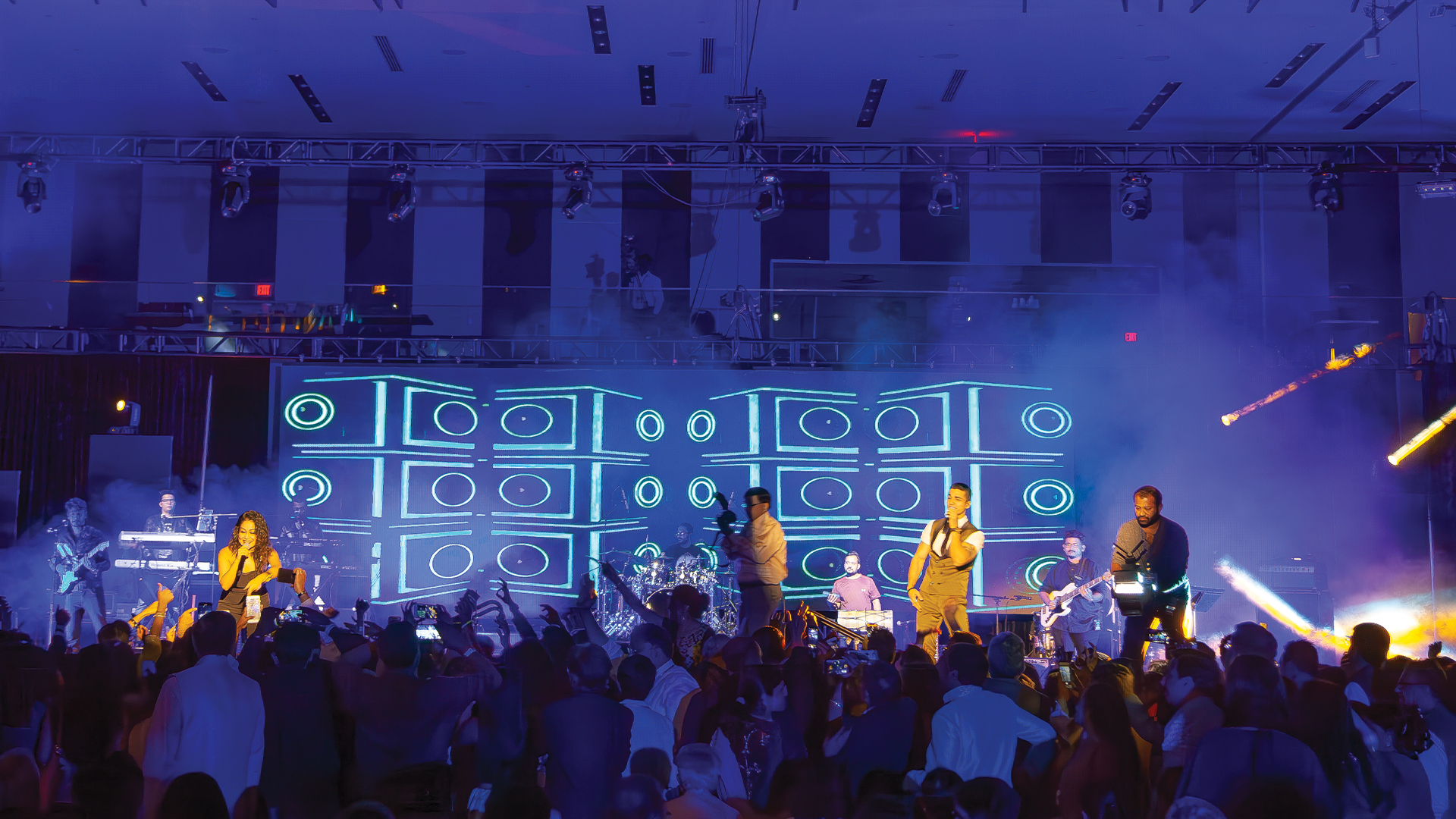
Beyond the Backdrop: The LED Wall as Active Creative Participant
The evolution of the LED video wall in corporate event production has progressed through distinct phases, each representing a fundamental rethinking of the wall’s creative role. Phase one was purely functional: the LED wall as a giant presentation screen, displaying PowerPoint decks and product photography in a size appropriate for large conference rooms. Phase two was atmospheric: the LED wall as a dynamic backdrop, cycling through branded graphics and motion content to create visual context for keynote speakers. Phase three — the one that is currently redefining high-end corporate event design — is interactive, where the LED wall responds to, participates in, and transforms the live performance of speakers, performers, and audiences in real time.
The technical infrastructure enabling phase-three LED wall interaction represents a convergence of technologies from disparate fields: game engine real-time rendering from the entertainment software industry, motion capture and computer vision from film visual effects, data visualization APIs from the business intelligence sector, and media server platforms from the live events world. When these technologies are integrated coherently — as they are in the leading corporate production environments of companies like George P. Johnson, Freeman, and Sparks — the result is an LED wall that is no longer a display device but a responsive environment.
Real-Time Content Generation: Engines Behind the Magic
The dominant real-time content generation platform in corporate LED wall applications is Unreal Engine by Epic Games — a technology migrated from AAA video game production that has found its most commercially significant non-gaming application in corporate and entertainment production. Unreal Engine’s Lumen global illumination system and Nanite virtualized geometry render photorealistic three-dimensional environments in real time at resolutions appropriate for large LED walls, enabling corporate productions to display environments — architectural spaces, product visualizations, data landscapes — that respond dynamically to live inputs without pre-rendered content latency.
The integration between Unreal Engine and disguise media servers — specifically the disguise RX II processing units — has become the technical backbone of interactive corporate LED deployments. disguise’s Multi-Transport Protocol (MTP) allows Unreal Engine to drive pixel content directly to LED walls via the disguise system, while the disguise layer maintains show control integration with GrandMA3 lighting, d&b Soundscape audio, automation systems, and broadcast tally signals — creating a unified show control environment where the interactive LED content exists as one layer in a comprehensively coordinated production.
Motion Tracking and Performer-Reactive Environments
The most dramatically interactive LED wall applications in corporate events involve performer-reactive content — visual environments that track the position and movement of speakers or performers on stage and generate corresponding visual responses. Blacktrax — a real-time performer tracking system developed by PRG that uses IR beacon transmitters worn by performers and ceiling-mounted cameras to provide centimeter-accurate position data — feeds tracking information to the content system, which maps performer position to generative visual responses on the LED wall behind them.
Corporate productions using this technology have created environments where a CEO’s movement across the stage surface generates expanding visual patterns in the LED wall, where audience sections responding to interactive polling via event apps trigger corresponding color shifts across the wall surface, and where data visualizations displayed on the wall update in real time from live business data feeds — sales figures, social media metrics, product launch countdown timers — creating a content environment that is literally impossible to pre-render because the data it displays does not exist until the moment of display.
Touch and Gesture Interfaces
A growing application area within corporate LED interactivity is large-format touch and gesture interfaces that allow conference delegates and event attendees to interact directly with LED wall content. Samsung’s interactive LED business display range and Leyard’s Touch Series panels provide capacitive touch capability at display scales approaching 10 meters diagonal — creating shared interactive surfaces where groups of conference attendees can simultaneously manipulate data visualizations, navigate product configurators, or collaboratively annotate strategic planning content displayed at room scale.
For events where physical touch interaction is impractical due to stage separation, gesture recognition systems using Microsoft Azure Kinect or Intel RealSense depth cameras enable speakers to interact with LED wall content through hand gestures tracked in real time. Productions at technology conferences including Mobile World Congress and Salesforce Dreamforce have used gesture-driven LED wall interaction to enable live product demonstrations that use the wall as an oversized interactive display visible to thousands of attendees — a communication strategy that creates memorable impact far beyond the capacity of any conventional presentation technology.
The Design Language of the Interactive Wall
The shift toward interactive LED walls has created demand for a new category of creative professionals: the interactive content designer who combines expertise in real-time graphics programming (typically Unreal Engine, TouchDesigner by Derivative, or VVVV), data API integration, interactive user experience design, and the practical realities of LED wall resolution and refresh rate constraints. Companies including Moment Factory in Montreal, Marshmallow Laser Feast in London, and Universal Everything in Sheffield have built international reputations on their ability to create interactive LED environments that function simultaneously as technological demonstrations and artistic experiences.
The corporate event LED wall has completed a journey from presentation technology to interactive environment in under fifteen years — a transformation driven by the convergence of game engine technology, media server integration, and the rising expectations of corporate audiences who experience high-quality interactive environments in consumer technology contexts and bring those expectations to the conference room. The LED wall that merely displays content is already obsolete in the highest-tier corporate productions. The LED wall that participates, responds, and collaborates with the human beings sharing its space is the new baseline.
